


 DOWNLOAD OUR PUBLIC LIABILITY INSURANCE CERTIFICATE
The Baldwin Trust Safeguarding Policy
Policy Policy statement
The Baldwin Trust aim to ensure that any children, young people, or adults at risk, are protected and kept safe from harm while they are with staff or volunteers in this organisation, and that we will challenge abuse whenever it is encountered during our activities. We will ensure our staff and volunteers era carefully selected, screened, trained, and supervised.
We consider child safeguarding, adult safeguarding and protection from sexual exploitation and abuse to be very important and The Baldwin Trust undertakes to ensure that all staff and volunteers who work with children, young peooplre adults at risk have been checked under recognised procedures and have received information that will enable them to recognise the signs of abuse and to follow the referral procedure to report any safeguarding concerns.
We also recognise that we have a legal duty under the Child Protection Acts) and The Human Rights Acts) to ensure that we act appropriately if we encounter any child, young persons, or adult at risk protection issue.
Scope of the policy
The policy is to be used by any member of staff or volunteer working directly with children and young people, and adults at risk, and to any other support staff or Trustees of the organisation who become involved in a child protection concern in the course of their work. Children, young people, adults at risk and parents/carers are informed of the policy as appropriate.
The policy applies to anyone with whom we are in contact in the course of our work, who is a child, a young person, or adult at risk. Where the policy or procedure refers to a 'child' or 'young person' we mean anyone who has not yet reached the age of 18 years. Where the policy refers to an 'Adult at Risk', we mean anyone who is 18 years or older and who is vulnerable according to the definition in the Leicester Safeguarding Adults Board Policy and Procedure.
This policy will be reviewed, endorsed, and approved by the Trustees annually, when legislation changes and following any internal change.
Purpose of this Policy and Procedure
This policy and procedure set out how The Baldwin Trust implements safeguarding for children, young people, and adults at risk with whom they come into contact within the course of their work.
We are committed to devising and implementing policies so that everyone within the organisation accepts their responsibilities for safeguarding children, young people and adults at risk from abuse and neglect. This means following procedures to protect them and reporting any concerns about their welfare to the appropriate authorities.
This policy and procedure will help us to achieve this by:
- Supporting us to safeguard children, young people, and adults at risk in practice, by defining abuse and informing us what to do.
- Ensuring we all work to the same policy and procedure.
- Making sure we are accountable for what we do.
- Being clear what roles and responsibilities we all have in safeguarding.
- Saying what staff can expect from the organisation to help them work effectively.
Who is a Child, Young Person, Adult at Risk?
Child/Young Person
A child or young person means someone who is under 18 years of age, that is, has not reached their 18th birthday. This could refer to the child/young person we are working with directly, or the child of one of these young persons, or of another person, with whom we are in contact in the course of our work.
When concerns are raised about the child of a service user (child or vulnerable adult), the needs of the youngest takes precedence.
Adult at Risk
This policy applies to any 'Adult at Risk', defined by the following: Any person aged eighteen or over who-- Is or may need community care services by reason of mental or other disability, age or illness; and
- Is or may be unable to take care of him or herself, or unable to protect him or herself against significant harm or exploitation.
Objectives of Policy
We will achieve the outcome by having these things in place:
- Safe organisational ethos.
- Safe environment.
- Safe processes for working with service users.
- Safe collection and use of information, and ways of communicating.
- Safe staff and volunteers.
Principles
In support of these objectives, we are committed to the following principles.
To achieve a safe ethos, we will:
- Promote the safety of children, young people, and adults at risk in all our activities.
- Treat all children, young people and adults fairly in being able to access services which meet their needs, regardless of gender, ethnicity, disability, sexuality or beliefs.
To achieve a safe environment, we will:
- Ensure the welfare and safety of children, young people and adults at risk is paramount in all our activities.
- Take all reasonable steps to protect service users from harm, discrimination, and degrading treatment.
- Regularly assess and review safety risks which arise from premises, activities, and equipment.
To achieve safe processes, we will:
- Take all suspicions and allegations of abuse, from inside or outside the organisation, seriously, and respond to them promptly and appropriately
- Be clear about everyone's roles and responsibilities
- Implement safeguarding procedures that are compliant with the expectations of the Leicester City and County safeguarding arrangements.
- Have in place clear arrangements for how we would respond to concerns about how we implement safeguarding in practice within the organisation.
To achieve safe information, we will:
- Be clear with service users how the things they tell us will be used.
- Communicate promptly and clearly within The Baldwin Trust and with external agencies and follow the requirements of information sharing protocols in Leicester and Leicestershire.
- Keep good records of our work with service users and also of our management of volunteer's work.
- Hold service users' information with care, and use it for agreed purposes only.
To achieve safe staff, we will:
- Recruit trustees, staff and volunteers with regard to their suitability for work with children, including use of enhanced Disclosure and Barring Service checks where appropriate.
- Provide Trustees, staff and volunteers with guidance and training in their safeguarding role, and ensure they have access to our policies and procedures.
- Make sure everyone always has access to advice on safeguarding in the course of their work.
- Be clear with everyone what their individual role and responsibility is in safeguarding.
- Support staff and volunteers to carry out their job with appropriate supervision.
What is Child Abuse or Neglect?
Abuse and neglect are forms of maltreatment of a child. Somebody may abuse or neglect a child by inflicting harm, or by failing to act to prevent harm Abuse means a child's rights and needs are not being met as defined in The Children's Act 2004 and the United Nations Convention on the Rights of the Child (1989). Children may be abused in a family or in an institutional or community setting; by those known to them or, more rarely, by a stranger. Abuse may occur through the actions of an adult or adults, or another child or children. Further detailed definitions of types of abuse are contained in Appendix 1.
Where a child is disabled, injuries or behavioural symptoms may mistakenly be attributed to his/her disability rather than the abuse. Similarly, where a child is black or from a minority ethnic group, aggressive behaviour, emotional and behavioural problems, and educational difficulties may be wrongly attributed to racial stereotypes, rather than abuse. Cultural and religious beliefs should not be used to justify hurting a child. Safeguards for all children and young people are the same regardless of disability or ethnicity.
What is abuse of an Adult at Risk?
Abuse is a violation of a person's rights or dignity by someone else. It can be done by anyone including relatives and family members, professional staff, paid care workers, volunteers, other users of services, neighbours, friends and associates or strangers. Definitions of abuse are contained in Appendix 2.
Dealing with any Concerns and Reporting Procedure
Inform
During your work with The Baldwin Trust you may:
- hear children's or vulnerable adult conversations of an inappropriate nature.
- see worrying behaviour in the treatment of a child or adult at risk.
- witness a disclosure directly to you.
which may be cause for concern.
If a child or adult at risk discloses information
- Never guarantee absolute confidentiality as Child Protection will always have precedence over any other issues.
- Listen rather than question him / her directly. Offer him / her reassurance without making promises and take what they say seriously.
- Allow them to speak without interruption. Accept what is said and do not overreact.
- Advise that you will try to offer support, but that you must pass the information on
- Explain what you have to do and whom you have to tell and that it can't be kept secret.
Reporting your concerns
Report your concerns as soon as possible and at the latest within 24 hours of the incident.
The process for raising and dealing with any concerns or allegations is as follows:
➢ First step
Any member of staff (paid or unpaid from The Baldwin Trust is required to report any concerns in the first instance to their Designated Safeguarding Lead (DSL) or their Deputy.
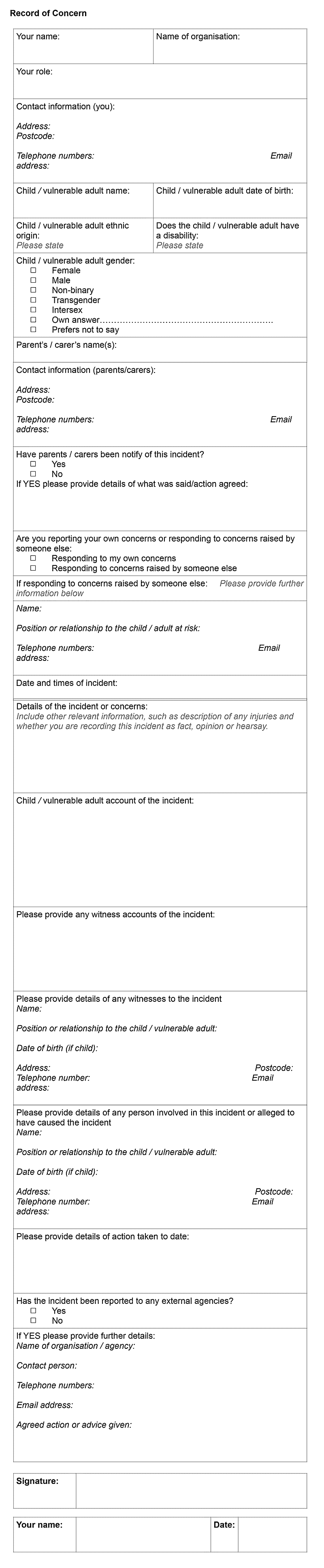
Complete the Baldwin Trust 'Record of Concern' form (see Appendix 3)
- Do this as soon as possible after the disclosure whilst it is still fresh information.
- Write in pen (NOT pencil) and write eligibly and clearly.
- Use the person's exact words as much as possible.
- If you can't access a 'Record for Concern' form, write the information down on a piece of paper and then write it up on the 'Record for Concern' form as soon as possible afterwards. Keep both versions of the report together.
- If you need to make any additions to the report, add this as an addendum, signing and dating it
➢ Second step
DSL or Deputy to contact Leicestershire Count Council
- Children: First Response Team for urgent concerns 0116 3050005
- Vulnerable Adults: Adult Social Care (within working hours) 0116 3050004
- Vulnerable Adults: Emergency Duty Team (out of working hours) 0116 2551606
If the child or vulnerable adult is in immediate danger, call the police on 999.
You can also contact the NSPCC directly on 0808 8005000.
➢ Third step
Follow the advice provided.
The Baldwin Trust will require a copy of the 'Record for Concern' form, which will be stored in a confidential file.
Any safeguarding concerns will be passed on to the Designated Safeguarding Lead or their Deputy immediately or as soon as practical and they will help to deal with the issue. The police will be contacted if it is thought a crime has been committed.
If any concerns involve or are about the Designated Safeguarding Lead or their Deputy, then they should contact the relevant local authority in the city or county on the contact numbers listed below.
Whistleblowing
The Baldwin Trust recognises its duty to report concerns or allegations against its own staff (paid or unpaid within the organisation or by a professional from another organisation.
If you have concerns about a member of The Baldwin Trust, please follow the three steps in the Disclosure Procedures above.
If the concern or allegation is against the Designated Safeguarding Lead or their Deputy, then contact the local authority for advice (see second step).
You can also contact the NSPCC Whistleblowing Advice Line to report your concerns and/or if
- Your organisation doesn't have clear safeguarding procedures to follow.
- You think your concern won't be dealt with properly or may be covered-up.
- You've raised a concern, but it hasn't been acted upon.
- You're worried about being treated unfairly.
The NSPCC Whistleblowing Advice Line can be contacted on 0800 0280285.
Contact Details
Designated Safeguarding Lead: Richard Jayes 07592 621120
Deputy Designated Safeguarding Lead: Barbara Matthews 07973 312357
Children:
Phone: 0116 454 1004 (24-hour service) or contact the police on 0116 222 2222
Visit: Customer Service Centre, 91 Granby Street, LE1 6FB to call from a free telephone.
Adults
Telephone: 0116 454 1004 (Monday to Thursday 8.30am to 5pm, Friday 8.30am to 4.30pm) Emergency number: 0116 255 1606 (6pm to 8am) Visit: Customer Service Centre, 91 Granby Street, LE1 6FB
Leicester Safeguarding Children Board: https://www.lcitylscb.org/contact-us/
Leicester Safeguarding Adults Board: https://www.leicester.gov.uk/health-and-social-care/adult-social-care/safeguarding-adults-board/
Leicester City Council: https://www.leicester.gov.uk/contact-us/concerned-about-a-child-or-an-adult/
Further information and contacts to report any concerns in the County:
Children:
First Response Children's Duty Team - 0116 305 0005 (24-hour line)
Adults:
Adult Social Care: 0116 305 0004 (Monday to Thursday, 8.30am to 5pm, Friday 8.30am to 4.30pm)
Emergency Duty Team: 0116 255 1606 (Evenings, weekends, Bank Holidays)
Leicestershire & Rutland Safeguarding Boards: for children and adults: https://lrsb.org.uk/
Date Issued September 2025 Review no later than: September 2026
Appendix 1
Definitions of Abuse in Children and Young People
Physical Abuse
Physical abuse may involve hitting, shaking, throwing, poisoning, burning or scalding, drowning, suffocating, or otherwise causing physical harm to a child. Physical harm may also be caused when a parent or carer fabricates the symptoms of, or deliberately induces or causes ill health to a child whom they are looking after. This situation is called Induced Fabrication Illness by a Carer (formerly known as Munchausen’s by proxy).
Emotional Abuse
Emotional abuse is the persistent emotional maltreatment of a child such as to cause severe and persistent adverse effects on the child’s emotional development. It may involve conveying to children that they are worthless or unloved, inadequate, or valued only insofar as they meet the needs of another person. It may feature age or developmentally inappropriate expectations being imposed on children. It may involve causing children frequently to feel frightened or in danger, or the exploitation or corruption of children. Witnessing the harm of another person, such as in the case of domestic violence, is a form of emotional abuse. Some level of emotional abuse is involved in all types of ill treatment of a child, though it may occur alone.
Sexual Abuse & Sexual Exploitation
Sexual abuse involves forcing or enticing a child or young person to take part in sexual activities, including sexual exploitation, whether the child is aware of what is happening, and whether it is for money or reward or not. The activities may involve physical contact, including penetrative contact (e.g. rape and buggery) or non-penetrative acts. They may include non-contact activities, such as involving children in seeing or receiving or sending sexually suggestive emails or text-messages, or inappropriate behaviour in Internet chat rooms, involving children looking at, or in the production of, pornographic material of watching sexual activities, or encouraging children to behave in sexually inappropriate ways.
Neglect
Neglect is the persistent failure to meet a child’s basic physical and/or psychological needs, likely to result in the serious impairment of the child’s health or development. Neglect may occur because of maternal substance abuse during pregnancy. Once a child is born, neglect may involve a parent or carer failing to provide adequate food, shelter and clothing, failing to protect a child from physical harm or danger, failure to ensure adequate supervision including the use of inadequate caregivers, or the failure to ensure access to appropriate medical care or treatment. It may also include neglect of, or unresponsiveness to, a child’s basic emotional needs.
Abuse of Disabled Children
Disabled children are at increased risk of abuse and those with multiple disabilities are at even more significant risk both of abuse and neglect. Parents of disabled children may experience multiple stresses. This group of children may be particularly vulnerable to abuse for several reasons including:
- Having fewer social contacts than other children.
- Receiving intimate personal care from a larger number of carers.
- Having an impaired capacity to understand what they are experiencing is abuse or to challenge the abuser.
- Having communication difficulties resulting in difficulties in telling people what is happening.
- Being reluctant to complain about fear of losing services.
- Being particularly vulnerable to bullying or intimidation.
- Being more vulnerable to abuse by peers than other children.
Disability is defined as:
A major physical impairment, severe illness and/or a moderate to severe learning difficulty; An ongoing high level of dependency on others for personal care and the meeting of other basic needs.
Bullying
Bullying may be defined as deliberately hurtful behaviour, usually repeated over a period, where it is difficult for those bullied to defend themselves. It can take many forms, but the three main types are physical (e.g. hitting, kicking, theft), verbal (e.g. racist or homophobic remarks, threats, name calling) and emotional (e.g. isolating an individual from the activities and social acceptance of their peer group). There is increasing use of new technologies as a tool for bullying and such incidents should be taken seriously.
Self-Harming Behaviour
Children and young people who harm or attempt to harm themselves should be taken seriously. The self-harming behaviour may cause impairment of the child’s health or development and in some circumstances present significant harm or the risk of significant harm.
Self-harming behaviour may also arise alongside eating disorders and/or drug misuse.
Female Genital Mutilation (FGM)
Female genital mutilation is a collective term for procedures that include the removal of part or all the external female genitalia for cultural or other non-therapeutic reasons. The practice is medically unnecessary, extremely painful and has serious physical and mental health consequences both at the time and in later life. The procedure is typically performed on girls of 4 -13 years but may be performed on newborn babies or on young women. FGM can result in death.
FGM is a criminal offence (Prohibition of Female Circumcision Act 2003). Under the act it is an offence to arrange, procure, aid or abet female genital mutilation. Parents/carers may be liable under this act.
It is also an offence to allow the procedure to be undertaken in another country. Where agencies become aware that a girl is at risk of FGM a referral should be made to Children’s Social Care.
Domestic Violence as Abuse
Domestic Violence is defined by the Home Office as: ‘Any incident of threatening behaviour, violence, or abuse (psychological, physical, sexual, financial or emotional) between adults who are or have been intimate partners or family members, regardless of gender or sexuality. This includes issues of concern to black and minority ethnic (BME) communities such as so called 'honour killings'.
The term domestic violence is used to include any form of physical, sexual, or emotional abuse
between people in a close relationship. It can take several forms such as physical assault, sexual abuse, rape, threats and intimidation. It may be accompanied by other kinds of intimidation such as degradation, mental and verbal abuse, humiliation, deprivation, systematic criticism, and belittling.
The term domestic violence includes the term domestic abuse.
Forced Marriage
A forced marriage is one that is conducted without the full consent of both parties and where duress is a factor. Forced marriage can amount to sexual and emotional abuse and put children or adults at risk of physical abuse. In circumstances where there are concerns that someone is at imminent risk of a forced marriage urgent referrals should be made to Children’s Adults’ Social Care.
In the case of a young person at risk of forced marriage it is likely that an initial discussion with the parent, carer or other community member may significantly increase the level of risk to the young person.
Internet Harm
Sexual exploitation (see above) also includes non-contact activities, such as involving children in seeing or receiving or sending sexually suggestive emails or text-messages, or inappropriate behaviour in Internet chat rooms, involving children looking at, or in the production of, pornographic material of watching sexual activities, or encouraging children to behave in sexually inappropriate ways.
Trafficking
Children can be trafficked into, within and out of UK for many reasons and all different types of exploitation. Trafficking is a form of child abuse and needs an appropriate safeguarding response. Any child who is recruited, transported, transferred, harboured, or received for exploitative reasons is considered to be a victim of trafficking, whether or not they have been forced or deceived. This is because it is not considered possible for children in this situation to give informed consent. Even when a child understands what has happened, they may still appear to submit willingly to what they believe to be the will of their parents or accompanying adult. It is important these children are protected too.
Children are trafficked for many reasons, including sexual exploitation, domestic servitude, labour, benefit fraud, forced marriage, begging and involvement in criminal activity such as pick pocketing, theft and working on cannabis farms. They are likely to be subjected to other forms of abuse, as a means of coercing and controlling them.
Trafficking is carried out by individual adults and organised crime groups.
Sexual activity with child/young person under the age of 18 or living away from home.
Consensual sexual activity involving a young person under 18 years is not abusive, but it may be. A child’s or young person’s ability to consent can be impaired due to lack of freedom, capacity or choice; for example because of an age/power imbalance; because it is leading into sexual exploitation; because one person is in a position of trust with the other (e.g. a teacher); where one person is vulnerable because of disability or capacity; where the child/young person is in the care of another away from home. No child under the age of 13 or under can consent to any sexual activity according to the Sexual Offences Act (2003).
Appendix 2
Definitions of abuse in Vulnerable Adults
Physical
This could be hitting, slapping, pushing, and kicking.
Sexual
This includes rape and sexual assault or sexual acts to which the adult at risk:
- Has not consented.
- Could not consent.
- Was pressured into consenting.
Emotional/Psychological
This could be:
- Emotional abuse
- Threats of harm or abandonment
- Depriving the person of contact
- Humiliating
- Blaming
- Controlling
- Intimidating
- Coercing
- Harassing
- Verbally abusing
- Isolating
- Withdrawing a person from services or support networks
Financial or material
This includes:
- Theft
- Fraud
- Exploitation
- Pressure in connection with wills, property, inheritance or financial transactions misusing or misappropriating property, possessions or benefits.
Neglect or acts of omission
This includes:
- Ignoring medical or physical care needs
- Failing to provide access to appropriate health care, social care, or education services.
- Misusing medication
- Inadequate nutrition or heating
Discriminatory
This includes:
- Racist behaviour
- Sexist behaviour
- Harassment based on a person’s ethnicity, race, culture, sexual orientation, age or disability.
- Other forms of harassment, slurs, or similar treatment
Appendix 3
The Baldwin Trust Equality & Diversity Policy
Purpose
This policy sets out the Baldwin Trust's commitment towards the development of inclusive and supportive learning and working environments where all individuals have the opportunity to fulfil their potential.
Scope
This policy applies to all members, visitors, contractors, and individuals with honorary status will also be expected to abide by this policy.
Definitions
A set of definitions used in this policy is set out in Appendix .1
Legislative Context
This policy is set within the following legislation:
- The Equality Act 2010
- Rehabilitation of Offenders Act (1974)
- Health and Safety at Work Act (1974)
- Trade Union Reform and Employment Rights Act (1993)
- Criminal Justice and Public Disorder Act (1995)
- Protection from Harassment Act (1997)
- Crime and Disorder Act (1998)
- Human Rights Act (1998)
- Employment Relations Act (1999)
- Management of Health and Safety at Work Regulations (1999)
This policy will be reviewed in the light of any new legislation.
Policy Statement
The Baldwin Trust is committed to supporting, developing and promoting equality and diversity in all of its practices; and it aims to establish an inclusive culture, free from discrimination, harassment, and victimisation.
The Baldwin Trust will, in carrying out its activities, have due regard to:
- The promotion of equality of opportunity.
- The promotion of good relations between different groups.
- The elimination of unlawful indirect and direct discrimination.
In publishing this policy statement, the Baldwin Trust is committing to the following principles:
- To use equality information to inform the Baldwin Trust's planning activities.
- To be active in meeting the public sector general and specific equality duties which will be informed by data and considered analysis.
- To deliver and monitor the equality and diversity policy using evidence-based data.
- To support members to meet their equality and diversity responsibilities through learning and development programmes.
- To ensure that equalities information is accessible, current, and shared openly whilst observing data protection.
- To monitor all stages of the employment and volunteering process, with a view to acting where appropriate.
- To work towards establishing a workforce and volunteer base that reflects the diversity of local and regional communities.
Responsibilities
The Chairperson is responsible for implementing this policy statement and in doing so entrusts the Baldwin Trust to:
- Ensure that the Baldwin Trust meets its legal obligations relating to equality and diversity.
- Oversee the development, monitoring and implementation of the Baldwin Trust's equality and diversity policies and practice.
The Baldwin Trust's Trustees are responsible for:
- Ensuring that procedures relating to staff and volunteer recruitment, selection, career development, discipline and grievance are carried out in accordance with the statutory duties to promote equality and eliminate discrimination.
- Fostering a culture in which equality and diversity considerations are embedded into their work areas.
- Ensuring members are encouraged and enabled to reach their full potential, irrespective of their background or protected characteristic.
- Conducting equality analysis on policies and procedures to demonstrate that they have paid due regard to the needs of individuals with protected characteristics.
- Ensuring reasonable adjustments are made available for members in accordance with the requirements of current legislation.
Members of the Board of Trustees are responsible for:
- Supporting, implementing and abiding by the aims and contents of this policy statement.
- Using their role to promote equality of opportunity for members.
- Contributing to an inclusive environment which celebrates diversity.
Communication
This policy is available to all members and the general public.
Breach of the policy
The Baldwin Trust will take seriously any instances of non-adherence to the Equality and Diversity Policy by members and visitors. Any instances of non-adherence will be investigated with the intent of resolving such matters.
Anyone who believes there has been a breach of this policy may raise this through the Board of Trustees.
Review
The policy will be reviewed every two years by the Board of Trustees.
Date issued: September 2023 Review no later than August 2025
Appendix 1
Definitions
Direct discrimination
Actions where people are treated less favourably than others on the grounds related to their identity as one of the above protected groups.
Diversity
Recognising, valuing, and taking account of individuals' different backgrounds, knowledge, skills and experiences to create a more productive and effective community.
Equal opportunity
This is the right of individuals and protected groups to equality of access and outcome in employment and service delivery.
Equality
A situation where all are enabled to participate and where everyone can fulfil their potential.
Equality analysis
Equality analysis is a way of considering the effect on different groups protected from discrimination by the Equality Act, such as people of different ages. There are two reasons for this:
- To consider if there are any unintended consequences for some groups.
- To consider if the policy will be fully effective for all target groups.
It involves using equality information, and the results of engagement with protected groups and others, to understand the actual effect or the potential effect of your functions, policies, or decisions. It can help you to identify practical steps to tackle any negative effects or discrimination, to advance equality and to foster good relations.
Harassment
There are three types of harassment which are unlawful under the Equality Act:
- Harassment related to a relevant protected characteristic.
- Sexual harassment.
- Less favourable treatment of a person because they submit to or reject sexual harassment or harassment related to sex.
Pregnancy and maternity are not protected directly under the harassment provisions, however, unwanted sexual behaviour will amount to harassment related to sex.
Indirect discrimination
This occurs where a condition or requirement has been put in place which applies to all, but, in practice, has a detrimental effect upon a group of individuals that cannot be fully justified.
Positive action
This is action taken by an organisation to provide development opportunities for 'Protected groups' who are demonstrably and statistically under-represented within the organisation.
Protected groups
Equality legislation currently provides protection against unlawful discrimination in employment and service delivery on the following grounds:
Age Disability Gender Identity
Marriage and civil partnership
Maternity and Paternity
Race
Sex
Religion and Belief
Sexual orientation
Victimisation
This is the treatment of someone less favourably because they have made or might make a complaint about discrimination under one of the above protected group categories.
The Baldwin Trust Health and Safety policy statement
- We have a duty of care to our clients, the general public and our volunteers to control any health and safety issues arising from our activities.
- We will observe best practice as advised by relevant organisations.
- To regularly consult with our volunteers on health and safety issues which may arise.
- To provide and maintain safe boats and any installed appliances and equipment.
- To ensure we abide by COSHH guidelines.
- To provide information, instruction and supervision to all our volunteers.
- To ensure our volunteers are competent to do their allotted tasks by providing adequate training.
- To ensure our volunteers are aware of all the risks associated with operating narrowboats on inland waterways.
- To ensure volunteers involved with maintenance follow safe practice.
- To review and revise this policy at regular intervals guided by the HSE (document HSG192)
Date Issued February 2025 Review no later than February 2026
The Baldwin Trust Volunteering Policy
Introduction
The Baldwin Charitable Trust exists to enhance the health and well-being of the disadvantaged, of all ages, within our communities
In line with this mission The Baldwin Trust seeks to involve volunteers to:
- Ensure our services meet the needs of our clients and their carers.
- Provide new skills and perspectives.
- Increase our contact with the local community we serve.
- Reduce loneliness.
- Increase access to the rivers and countryside of the local counties for learning opportunities.
Principles
This Volunteering Policy is underpinned by the following principles:
- The Baldwin Trust will ensure that volunteers are properly integrated into the organisational structure and that mechanisms are in place for them to contribute to The Baldwin Trust's work.
- The Baldwin Trust does not aim to introduce volunteers to replace paid staff. (if this applies)
- The Baldwin Trust expects that staff at all levels will work positively with volunteers and, where appropriate, will actively seek to involve them in their work. (if this applies)
- The Baldwin Trust recognises that volunteers require satisfying work and personal development and will seek to help volunteers meet these needs, as well as providing the training for them to do their work effectively.
Practice guidelines
The following guidelines deal with practical aspects of the involvement of volunteers
Recruitment
Initially, an application form is sent to prospective volunteers to fill in; this includes the request for references. The applicant is then interviewed to find out what they would like to do, their skills, suitability and how best their potential might be realised
Volunteer agreements and voluntary work outlines
Each volunteer will be inducted at a formal induction meeting, handed a volunteer pack and asked for their verbal agreement to abide by the policies as stated in the documents.
Each volunteer is asked to sign a Volunteer Agreement (see Appendix 1). This is also signed by the Volunteer Co-ordinator.
Expenses
A "crew allowance" will be paid at the end of each season for all trips completed. Bona Fide expenses will be paid for volunteer tasks achieved outside of normal manning duties.
Induction and training
Al volunteers will receive an induction into The Baldwin Trust and their own area of work. Training will be provided as appropriate.
Support
All volunteers will have a named person as their main point of contact. At the outset, this will normally be the Training Manager or one of the training team supported by the Crew Allocation Manager. They will be provided with regular supervision to feedback on progress, discuss future development and air any problems
The volunteer's voice
Volunteers are encouraged to express their views about matters concerning The Baldwin Trust and its work.
Insurance
Al volunteers are covered by The Baldwin Trust's insurance policy whilst they are on the premises or engaged in any work on The Baldwin Trust's behalf.
Health and safety
Volunteers are covered by The Baldwin Trust’s Health and Safety Policy and Risk Assessment Policy, copies of which are in each induction pack.
Equal opportunities
The Baldwin Trust operates an Equal Opportunities policy in respect of both paid staff and volunteers. A copy is in the induction pack. Volunteers will be expected to have an understanding of and commitment to our Equal Opportunities policy.Problem solving
We aim to identify and solve problems at the earliest possible stage. A procedure has been drawn up for dealing with complaints either by or about volunteers. Please refer to Safeguarding Policy in the induction pack.
Date Issued January 2024 Review no later than January 2025
APPENDIX 1
Volunteer Agreement
Volunteers are a crucial and valued part of The Baldwin Trust. We really appreciate that you have chosen to volunteer with us. We will do our best to make sure your volunteer experience is both enjoyable and rewarding. We aim to be flexible and supportive and believe that the volunteer relationship is built on trust and mutual understanding.
This agreement sets out:
- What support you can expect from us as a volunteer and
- What we require from you as a volunteer
As a volunteer we ask that you:
- Strive for the best that you can do and complete your volunteering activities with dedication and commitment
- Be positive and support the work of the Baldwin Trust
- Go to any briefings and training that we think will help with your volunteering
- llow us to hold and use your personal data in accordance with the current legislative requirements
- Follow and operate within the Trust’s policies and procedures
- Act responsibly and within the law at all times
- Maintain confidentiality
- Value and respect the rights of clients
- Work in partnership with staff and volunteers to make society a better place for our beneficiaries
- Let the Volunteer Coordinator know if you are having any problems or if you have any complaints, concerns or feedback
- Having made yourself available for specific volunteering activities, to ensure that you follow the Trust’s guidelines if you are unable to meet these commitments
In return the Baldwin Trust will:
- Provide information about the Trust’s history, activities and vision
- Give information about and operate within our policies and procedures
- Offer training and support in your volunteering; when you become a volunteer you will be provided with a Trust uniform (fleece and polo shirt)
- Reimburse any pre-agreed expenses
- Strive to resolve and concerns you have fairly and reasonably, applying our complaints procedure when it is needed
- Respect and listen to your feedback and keep you informed of any changes
- Ensure, as far as we are able, your health, safety and welfare
- Encourage a positive and supportive volunteering experience
Signed
This agreement is not an employment contract and is not intended to be a legally binding contract; it can be broken by either party at any time.
1. Volunteer
Signed .....................................................................
PRINT NAME ............................................................
Date ........................................................................
2. The Baldwin Trust
Signed .....................................................................
PRINT NAME ............................................................
Position within the Baldwin Trust ..............................
Date ........................................................................
Privacy Policy
Our contact details:
Name: The Data Protection Officer
Address: c/o Syston Volunteer Centre, 18 School Street, Syston, Leicester, LE7 1HN
E-mail: chair@baldwintrust.co.uk
The type of personal information we collect:
We currently collect and process the following information where necessary:
- Name
- Address
- Email address
- Telephone number
- Emergency Contact details
- Financial information
How we get your personal information and why we collect it:
Most of the personal information we process is provided to us directly by you for one of the following reasons:
- To enquire about our trips, especially relating to dates, times, routes and access requirements
- To book and pay for a trip
- To volunteer with us
- To donate to the Trust
- To provide information about our services and
- To purchase items from us.
This data can be collected in a number of ways, such as online forms, telephone calls, personal contact, emails or by letter.
We use the information that you have given us to:
- Directly or indirectly provide the Trust's services. We may share this information with:
- Appointed bona fide sub-contractors for example DigiTickets, who undertake our online booking system, together with their nominated payment gateway.
Under the General Data Protection Regulation (GDPR), the lawful bases we rely on for processing this information are:
(a) Your consent. You are able to remove your consent at any time. You can do this by chair@baldwintrust.co.uk
How we store your personal information:
Your information is securely stored by referenced checked volunteers and specifically appointed sub-contractors.
We only keep your information for as long as we need it to fulfil the purposes for which it has been given to the Trust. We will then dispose of this information by either removing it from our electronic records of physically destroying any paper records.
Your data protection rights:
Under data protection law, you have rights including:
Your right of access - You have the right to ask us for copies of your personal information.
Your right to rectification - You have the right to ask us to rectify personal information you think is inaccurate. You also have the right to ask us to complete information you think is incomplete.
Your right to erasure - You have the right to ask us to erase your personal information in certain circumstances.
Your right to restriction of processing - You have the right to ask us to restrict the processing of your personal information in certain circumstances.
Your right to object to processing - You have the the right to object to the processing of your personal information in certain circumstances.
Your right to data portability - You have the right to ask that we transfer the personal information you gave us to another organisation, or to you, in certain circumstances.
You are not required to pay any charge for exercising your rights. If you make a request, we have one month to respond to you.
Please contact us at chair@baldwintrust.co.uk or Syston Volunteer Centre, 18 School Street, Syston, Leicester, LE7 1HN
if you wish to make a request
How to complain:
If you have any concerns about our use of your personal information, you can make a complaint to us at:
The Data Protection Officer
c/o Syston Volunteer Centre, 18 School Street, Syston, Leicester, LE7 1HN or by emailing chair@baldwintrust.co.uk
You can also complain to the ICO if you are unhappy with how we have used your data.
The ICO's address:
Information Commissioner's Office
Wycliffe HouseWater Lane
Wilmslow Cheshire
SK9 5AF
Helpline number: 0303 123 1113
ICO website: https://www.ico.org.uk
Date Issued February 2025 Review no later than April 2026
Cookies Policy
Google Analytics and Google Adwords
To enable us to make improvements to our website content and functionality, we use Google Analytics to monitor how people use our website.
Google Analytics helps us to understand which pages of our website people visit, how long they spend on each page, which documents are downloaded, whether there are problems when completing forms and which links people access
Data may also be collected and put together to make inferences about things such as your age, geographical location and interests, and it may be used by Google Adwords to display our adverts to you.
Anonymous data is passed to us from Google so we are unable to personally identify you. We do not hold any personal data collected by Google Analytics, nor can we access the data. You are therefore subject to Google Analytics' Data Privacy and Security. You can opt out of Google Analytics' tracking at any time by using Google Analytics' Opt-Out Browser Add-on.
You can opt out of personalised adverts by Google Adwords at any time by using your Ads Settings.
Website Links
We sometimes insert links on our website to other websites which we believe provide helpful and interesting information. However, you should note that we do not have any control over these other websites and such sites are not governed by this privacy statement. Once you have used any of these links to leave our site, we cannot be responsible for the protection and privacy of any information which you provide whilst visiting these sites.
Policy Amendments
We may, from time to time, update this Policy by posting a new version on our website. You should check this page occasionally to ensure you are familiar with any changes.
Cookies For Online Users
The Baldwin Trust website does not automatically capture or store personal information, other than logging the user's IP address and session information, such as the duration of the visit and the type of browser used. This is recognised by the web server and is only used for system administration and to provide statistics which The Baldwin Trust uses to evaluate use of the site.
Cookies are used for accessibility only; we do not use cookies for collecting user information. You may use your internet browser setting to disable new cookies being created and to delete those already captured.
Please be aware that disabling cookies may affect your browser experience when using the Baldwin Trust website.
Blocking Cookies
You can block cookies by activating the setting on your browser that allows you to refuse the setting of all or some cookies. However, if you use your browser settings to block all cookies (including essential cookies) you may not be able to access all or parts of our site.
Information on how to block cookies can usually be found within the "Help" feature of your browser. Information can also be found on the main browser websites. www.apple.com/safari (Apple Safari) www.google.com/chrome (Google Chrome) www.microsoft.com (Internet Explorer) www.mozilla-europe.org/en/firefox (Mozilla Firefox) www.opera.com (Opera)
Date Issued February 2025 Review no later than: June 2026
Access Policy
1. Marinas, Moorings and Boats
This statement is not intended to provide opinions about access suitability to the marinas and moorings where our boats are located. Rather, our intention is to provide an accurate description of the immediate surroundings of our boats and access to their mooring together with information about gaining access to the boats
General Statement
The Trust was founded in 1983 and since that time, people with mobility challenges and those who rely on carers have been regular guests on our trips. Consequently, our volunteers are experienced in welcoming guests who are supported by carers or who have mobility challenges. However, please be aware that our crew are not trained, or insured to physically assist service users, especially wheelchair users using the lift. The hirer must have enough suitable assistants to perform these tasks. Where guests require carer support, it is a requirement in all cases, that the guest is accompanied throughout the trip by their carer.
Information about this carer requirement and how guests and carers form part of the maximum number of guests on a trip is provided elsewhere.
Please contact us before you make a booking if you would like to know more Intormation about access.
Leicester Marina, Pinfold Road, Thurmaston, Leicester, LE4 8AS - mooring for Halseyon Days.
Vehicular access to the marina is barrier controlled. There is a speed limit on site and guests are asked to always adhere to this limit and respect those who live permanently on the boats in the marina.
Having accessed the site, free car parking is supplied and is located within 300 metres of the mooring for Halseyon Days (closer parking is available for "dropping off nearer to the boat).
Gravel pathways run from the parking areas to Halseyon Days. Once at the mooring, an access ramp leads down to the boat's pontoon.
Halseyon Days has a wheelchair lift (dimensions 84cm × 115cm) fitted ta the rear of the boat. Our volunteers are trained in the use of the lift.
Location details for Leicester Marina are located elsewhere.
Details of the onboard facilities are provided elsewhere.
Because of access issues, the Trust recommends the use of Halseyon Days for trips where guests require the use of wheelchairs.
Barrow Boating, Mil Lane, Barrow upon Soar, Loughborough, LE12 8LQ- mooring for Dandelion.
There is no parking for guests at Barrow Boating boatyard; rather guests are required to park appropriately on the roads near to the boatyard. We would ask that all guests using such parking are mindful of and considerate to the residents.
Parking should be possible within a 5-minute walk of Dandelion. This walk will initially be on pavements and subsequently, for approximately 250 metres, on a gravel path which runs parallel to the river.
Dandelion has a wheelchair lift (dimensions 90cm x 180cm) fitted at the front of the boat. Our volunteers are trained in the use of the lift.
Location details for Barrow Boating are located elsewhere
Details of the onboard facilities are provided elsewhere.
Because of access issues, the Trust recommends the use of Halseyon Days for trips where guests require the use of wheelchairs.
2. Assistance Dogs
Assistance Dogs are allowed on all Baldwin Trust trips subject to prior notification to and, agreement with the Trust; this must be done at the booking stage and will be confirmed in writing by the Trust.
We require that the dog complies with the terms of the Equality and Human Rights Commission stating that assistance dogs:
- highly trained.
- will not wander freely around the boat.
- will sit or lie quietly on the floor next to its owner and is trained to go to the toilet on command and so are unlikely to foul in a public place.
It is important that the person making the booking informs fellow passengers that a dog will be on board the boat.
Date Issued: January 2024 Review no later than: January 2025
Complaints Policy
We work hard to make sure our boats run on time and provide you with the excellent trip you expect. However, sometimes things can happen beyond our control. When this happens, we want to hear about them as soon as possible so that we can learn from your experiences.
In the event of something happening which you feel we need to know about, we ask that you:
- Bring the matter to the attention of the skipper and/or crew on the day of your trip, ideally at the time the problem occurs.
- If, however this is not possible or practical for any reason, or if you feel the matter needs more attention, please send an email as soon as possible, and certainly within 48 hours, to the following address: bookings@baldwintrust.co.uk
- We will acknowledge your email within 24 hours and try to provide a full reply within 72 hours. However, if more detailed investigations are required which prevent a full response within these timescales, then we will respond as soon as we are able to do so.
Date Issued: February 2025 Review no later than: May 2026
The Baldwin Trust Risk Assessment Policy
Activity description: Cruises on waterways for disabled and other groups.
Al skippers are fully trained to NCBA CCBM, and are First Aid Trained (First on Scene).
The boats hold current licenses and current Boat Safety Certificates.
AREA | HAZARD | WHO IS AFFECTED | RISK LEVEL | CONTROL MEASURES |
|---|---|---|---|---|
Car Parks. Passengers leaving vehicles. | Other vehicles passing by/parking. Injury from moving vehicles. | Passengers and crew | LOW | Crew to be aware of vehicles and to direct arriving passengers safe route to boarding pontoon. |
Route to boarding pontoon. | Risk of slips, trips, falls and inclines. | Passengers and crew | LOW | Crew to be aware of passengers arriving and directing them to the boarding pontoon. |
Boarding Pontoon. | Risk of slips, trip and falls into water. | Passengers and crew | MEDIUM | Crew to be aware of any damage or hazard and report to the Marina. |
Boarding Boats. | Risk of slips and falls onto the boat or into water. | Passengers and crew | MEDIUM | Crew to be aware of passengers. |
Boarding and movement of Wheelchairs. | Risk of Wheelchairs tipping. Risk of incorrect positioning on hydraulic lift. | Passengers and crew | MEDIUM | Crew to be aware of Wheelchairs and to supervise as necessary. Crew only to operate the hydraulic lift. |
Lift Operation. | Feet being under the edge of the lift during operation. | Passengers and crew | LOW | Lifts are fitted with an override system which is tested annually. |
Lift Operation. | Passengers stepping onto or Wheelchairs being wheeled onto the lift before it is fully raised. | Passengers and crew | LOW | Crew to be aware of ANY passenger or crew movement and to supervise as required. Crew only to operate the hydraulic lift. |
Lift Operation. | Feet being under the edge of the lift during operation. | Passengers and Crew | LOW | Lifts are fitted with an override system which is tested annually. |
Lift Operation. | Operating by persons other than Crew. NO ONE OTHER THAN TRAINED CREW SHOULD | Passengers and Crew | LOW | Lifts to be turned off when not in use by Crew. |
Roof. | Slips, trips and falls into the Water. | Passengers and crew | LOW | NO Crew or Passengers are allowed onto the roof at anytime. |
Main Cabin. | Slips and trips. | Passengers and crew | MEDIUM | Crew to monitor cabin areas for obstacles and hazards at all times and remove as and when required. |
Galley. | Boiling water, Steam and hot foods. | Passengers and crew | MEDIUM | NO drinks or food to be served whilst approaching or inside locks or whilst mooring up. All spillages to be cleaned up immediately. |
Stern Deck. | Passengers asking to see how the boat is run. | Passengers and crew | LOW | Skipper and Crew to be aware of Passengers whilst on the Stern Deck. Life Jackets are available. Under 18’s must wear buoyancy aids. |
Bow. | Passengers sitting outside. | Passengers | LOW | Skipper to highlight the dangers. Crew to monitor during cruise and under 18 year olds must wear buoyancy aids |
Bow (2). | Persons located in the bow when turning the boat in narrow channels. | Passengers and crew | MEDIUM | Skipper to ensure that the bow area is clear to avoid contact with bushes and trees at the canal side. |
Locks. | Passengers wishing to help with the locks Slips, falls into the water. | Passengers and crew | MEDIUM | Crew to advise the safe disembark and boarding of the Passengers. Crew to advise of the dangers of the locks and safe handling of the lock mechanics/ operation. Under 18’s must wear a buoyancy aid while operating locks. Over 18’s are strongly recommended to wear a buoyancy aid. |
Boat operation. | Collision, Grounding. | Passengers and crew | LOW | Operation of boats to be carried out by trained Skipper and Crew. |
Boarding Ramp movement when other boats passing by. | Passengers on Boarding Ramp. | Passengers and crew | MEDIUM | Crew to visually check to see if any boats are approaching and to STOP boarding until boats have passed by. |
Falling Overboard. | Shock and Water inhalation/ingestion. | Passengers and crew | HIGH | Skipper and Crew are trained in safety procedures. It is preferred that the skipper and crew wear buoyancy aids and lifejackets at all times. It is a requirement, however, that Skipper and Crew MUST wear these items when off the boat undertaking activities close to the water’s edge. |
Boarding Ramp movement when other boats passing by. | Passengers on Boarding Ramp. | Passengers and crew | MEDIUM | Crew to visually check to see if any boats are approaching and to STOP boarding until boats have passed by. |
Lift Operation. | Operating by persons other than Crew. | Passengers | LOW | Lifts to be turned off when not in use by Crew. |
Boat taking on water. | Wet clothes, shock, hypothermia. | Passengers and crew | LOW | Move boat to the bank and passengers to be evacuated A.S.A.P. Boats are fitted with bilge pumps which must be turned on. |
Gas Leak. | Inhalation, sickness, breathing difficulties. | Passengers and crew | LOW | Control Safety Alarm devices are fitted, isolator valves on gas cookers, heating boilers are Clearly marked. |
Fire onboard. | Smoke inhalation and burns. | Passengers and crew | LOW | Fire extinguishers are situated on the boats and are annually serviced Crew to ensure Passengers are moved away as far as possible from the fire. The Boat is to be moved to the bank and Passengers and Crew to be evacuated A.S.A.P. If necessary, the Fire Brigade are to be called by the Skipper or Crew. |
